
McHenry County Jail Mugshots Overview
The McHenry County Sheriff's Office runs the public inmate roster, and the version inspected does not display booking photos. The two roster PDFs, one sorted by name and one by date, carry identity and court fields. They do not carry a photo, a photo angle, or any prior booking-photo history. So a McHenry roster lookup will not return a mugshot the way some county jail galleries do.
There is no separate public booking-photo gallery or daily mugshot feed on the Sheriff's site either. The office does point to a mobile app for the most current inmate list, but no official text states that the app shows mugshots. The Most Wanted page does show images, yet that is a public-safety and warrant feature run with Crime Stoppers, not a booking-photo archive for everyone in the jail. In short, a booking photo in McHenry County is usually obtained by request, not by browsing.
Where to Look for McHenry County Booking Photos
Because the roster carries no photo, finding a McHenry County booking photo means working through a short list of official channels. Each one covers a different situation, and only some will ever hold an image. Start at the top and move down until the question is answered.
- The inmate roster: confirms custody and charges, but shows no booking photo.
- The Sheriff's Most Wanted page: may show a wanted person's image, only for warrant or public-safety listings.
- A FOIA request to the Sheriff: the main route for a booking photo that is not posted online.
- The court case file: holds charges and filings, but not booking photos, police reports, or evidence.
- State or federal locators: a state prison profile may carry a photo after sentencing; federal locators do not.
For most routine bookings, the realistic answer is the records request. The roster tells you a person is in custody, and the FOIA process is how an available photo is actually released.
What a McHenry County Booking Record Shows
Because the roster has no photo field, it helps to see exactly which fields a McHenry entry does carry. The table below highlights the missing photo and lists the data that is published alongside each name. This is the same record covered in more depth on the jail inmate records page.
| Field | What It Shows |
|---|---|
| Booking Photo | Not shown on the McHenry roster PDF; obtained by records request when available. |
| Name and DOB | Last, first, and middle, with date of birth and age. |
| JCA# | The jail control number used to identify the person. |
| Charges and Class | Plain-language charges and a class code such as X, 1, A, or B. |
| Date Confined | The date and time the person entered jail custody. |
| Custody status | "CURRENTLY CONFINED" or "RECENTLY RELEASED" with a date. |
Notice what is absent: no height, weight, race, or physical description beyond age and date of birth. That thin physical profile is one reason a booking photo, when it can be released, is requested separately through the Sheriff rather than read off the roster.
Are McHenry County Jail Mugshots Public Record?
In Illinois, a booking photo can be a public arrest record, but the law sets conditions. The Freedom of Information Act treats arrest information, including a photograph when it is available, as records that an agency must furnish within 72 hours of arrest. The same law lets an agency withhold an image when release would interfere with an investigation, endanger someone, or compromise jail security. A separate subsection limits how police may publish mugshots on social media for low-level offenses. So "public" does not mean "posted online for everyone."
Key Statutes:
Illinois FOIA, 5 ILCS 140/2.15 - Requires arrest-report information, including a photograph when available, within 72 hours, and allows withholding when release would interfere, endanger, or compromise security.
Illinois FOIA, 5 ILCS 140/7 - Lets agencies withhold or redact exempt records, including law-enforcement, juvenile, and safety-sensitive material.
One nuance trips people up. The social-media limit in section 2.15 bars law enforcement from posting mugshots for certain petty and low-level misdemeanor offenses on its social networking sites, unless the post helps find a missing person, a fugitive, or a wanted person. That is a publication rule for social media. It does not force every booking photo onto a public roster, and it does not by itself require the Sheriff to remove an image from a file.
How Long a McHenry County Mugshot Stays Public
Since the roster shows no photo at all, there is no on-roster window for a mugshot to age out of. The roster itself keeps a person listed while confined and for three days after release, then drops the entry from public view. A booking photo held in the Sheriff's files is a separate record, governed by the FOIA timing and exemption rules rather than the roster's three-day display.
What is and isn't public: The roster shows names, charges, case numbers, and custody status, but no booking photo. A photo, when it exists and is releasable, is obtained by a Freedom of Information Act request to the Sheriff. Juvenile, sealed, expunged, and safety-sensitive images can be withheld or redacted under Illinois law.
How to Request a McHenry County Booking Photo
When a booking photo is not online, the route is a Freedom of Information Act request to the Sheriff's Office. Be specific so the office can find the right record. Name the person, a date of birth if known, the arrest date, the jail control number if you have it, the case number, and the exact record you want, such as the booking photograph or arrest report.
- Open the Sheriff's FOIA request page and complete the web form, or send the request by mail, fax, email, or hand delivery.
- Identify the record as a booking photograph or arrest report and give the name, date of birth, arrest date, and case or JCA number.
- Ask for an electronic copy if you want a digital image rather than a paper print.
- Watch the response window: five business days to comply or deny, with a possible five-day extension, and 21 business days for commercial requests.
The Sheriff's FOIA form lays out the required fields and the fee and timing rules.
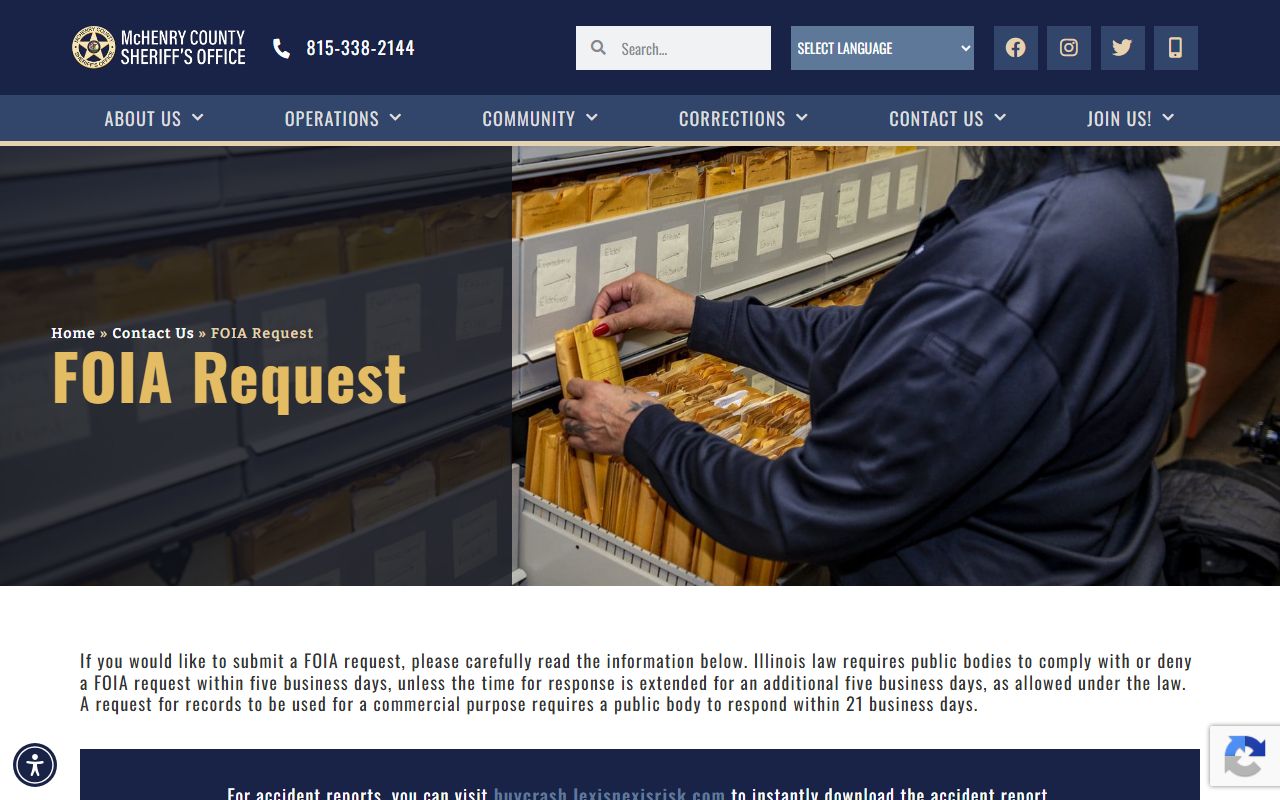
The FOIA request form notes that the first 50 black-and-white pages are free, with 15 cents per page after that and actual cost for color copies, so a single digital photo is usually an inexpensive request. The Records Division can also be reached at 815-334-4770.
Mugshot Removal and Sealed Records
The Sheriff's inspected pages do not publish a separate booking-photo removal policy. The reliable way to limit access to an arrest image is through the courts. If a case is expunged or sealed, that court process is what restricts the underlying record, and the Circuit Clerk excludes expunged and sealed cases from public files. The steps and the difference between sealing and expungement are covered on the court records after a jail arrest page.
Be cautious about commercial mugshot-publishing sites that promise removal for a fee. They are not official, they are not part of the county record, and clearing the court case does not automatically pull an image from a private site. The records-clearing route runs through the court and, where a record is held by the Sheriff, through the FOIA and sealing rules, not through a pay-to-remove service.
Federal and State Booking Photos
Federal custody works differently from the county jail. The Federal Bureau of Prisons locator shows identity and custody fields but does not publish booking mugshots the way some local galleries do, and federal pretrial detainees may be held through the U.S. Marshals or a contract facility with their own access rules. So a federal arrest will not produce a public mugshot the way people expect from a county roster.
State custody is its own system again. When a person is sentenced to the Illinois Department of Corrections, the statewide locator often publishes an offender photo on the individual's profile. That state photo is separate from the county booking photo and appears only after a person enters prison custody, not while they sit in the McHenry County jail awaiting trial.
This three-way split matters when you are tracking one person over time. A McHenry defendant may have no public photo at the pretrial stage, then appear with a state photo after a prison sentence, and never appear with a federal image even if a federal charge is involved. Matching the photo question to the right custody level avoids a long search in the wrong system. The roster confirms the county stage, the FOIA request covers the county photo, and the state locator covers the photo that appears only after sentencing.
Keeping a Mugshot Search Factual
Booking photos draw a lot of attention, and that has created an industry of private sites that repost them and then charge to take them down. Those sites are not official records, they are not maintained by the Sheriff, and they often carry outdated or wrong information. A person listed there may have had the charge dropped or the case sealed, yet the image lingers.
The records-oriented approach is simpler and more reliable. Use the roster to confirm custody, use the FOIA process to request an available photo, and use the court sealing or expungement process to limit a record after an eligible outcome. Treat a booking photo as one piece of a custody record, read alongside the charges and case status, rather than as a verdict on the person.