
McHenry County Court Records After a Jail Arrest
After a McHenry County arrest, the path to a court record runs through the prosecutor. Local police or the Sheriff make the arrest, the jail books the person, and the McHenry County State's Attorney's Office then decides what charges to file. The current State's Attorney is Randi L. Freese. The formal charges appear in the 22nd Judicial Circuit and the Circuit Clerk's case system, and that filing is the court record for the case. It can differ from the charges written at booking.
Keep the two sides straight. The booking and custody side lives on the jail roster, covered on the jail inmate records page, and booking photos are handled on the jail roster mugshots page. The court record is something else: it is the set of charges the prosecutor filed and the events that follow, tracked by case number through the clerk. The case number on a roster entry is the bridge that links a jail arrest to its court record.
How to Find McHenry County Court Records After an Arrest
The Circuit Clerk runs the public case-search portal where charges and case status appear. You can start from a name or, better, from the exact case number shown on the jail roster. The portal accepts a few search methods, listed in the table below.
| Search Field | Type | Notes |
|---|---|---|
| Case Number | Text | Strongest match; roster examples include 2025CF817 and 2024MT2180. |
| Ticket Number | Text | Used for traffic and ticket-based matters. |
| Defendant Name | Text | Last and first name search when the case number is unknown. |
- Open the McHenry County public case access portal from the Circuit Clerk site.
- Search by case number first; if it is unknown, search by defendant name or ticket number.
- Open the case and read the list of filed charges and hearing dates.
- Check each charge's class, status, and disposition before drawing any conclusion.
The Circuit Clerk homepage links to case information, copy requests, hours, and the courthouse address in Woodstock.

The Circuit Clerk homepage is the front door to those court records, and it is the right place to start once you have a name or a case number from the arrest. Illinois State Police, not the county portal, handles statewide criminal-history checks, so do not treat a single case search as a full background check.
McHenry County cases are heard in the 22nd Judicial Circuit, a single-county circuit that handles criminal, family, and civil matters at the Michael J. Sullivan Judicial Center in Woodstock. The circuit has eight circuit judges and eleven associate judges, and the courthouse shares the Government Center campus with the jail, the clerk, and the State's Attorney.
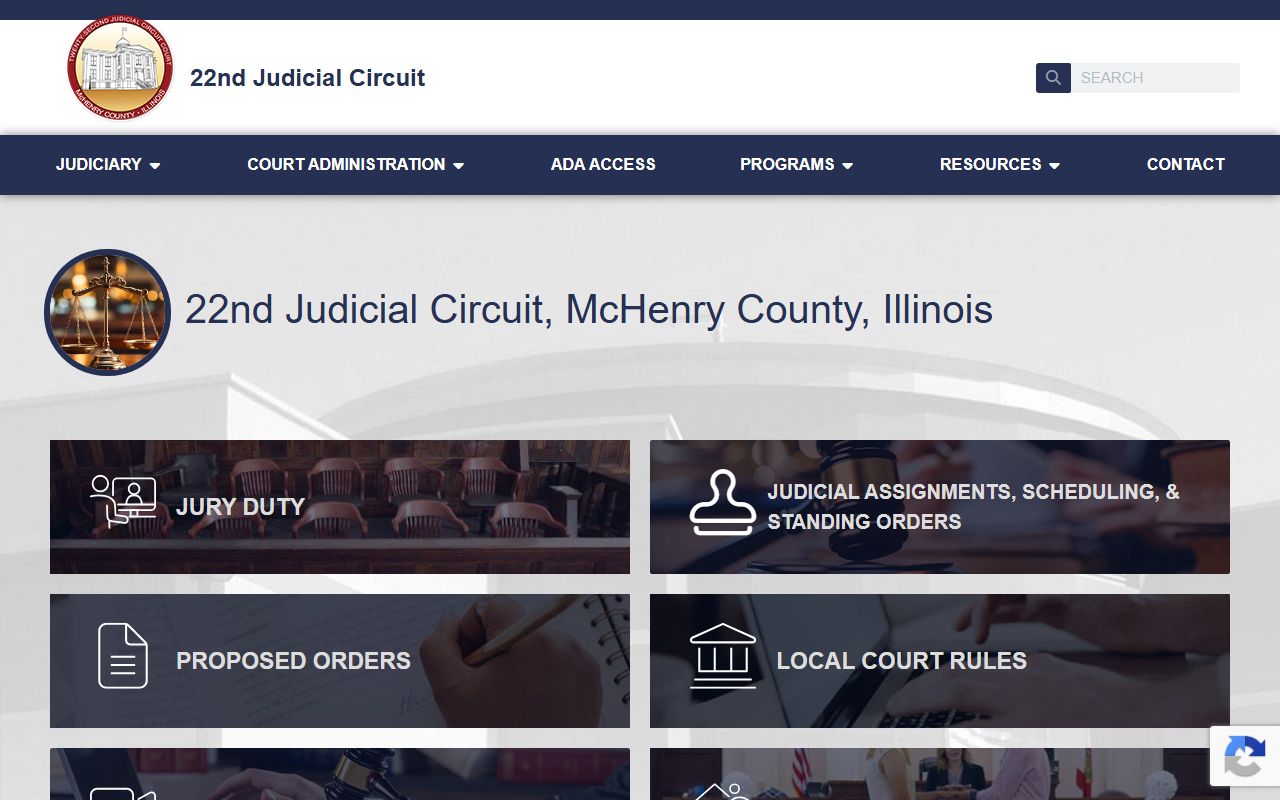
The 22nd Judicial Circuit site explains the court's jurisdiction and judges, which helps a reader understand which court holds the case after a McHenry County arrest. The clerk can be reached at 815-334-4190 for case and copy questions.
How Charges Get Filed After an Arrest: Complaint, Information, and Indictment
A court record begins when the prosecutor files a charging document. The arrest does not file the charge; the State's Attorney does. Illinois uses three main charging instruments, and which one is used depends on the offense and the procedure. The table sums up the differences.
| Complaint | Information | Indictment | |
|---|---|---|---|
| Filed By | Officer or prosecutor | Prosecutor | Grand jury |
| Common For | Misdemeanors and traffic | Many felonies | Serious felonies |
| Starts | The case | The case | The case |
A felony can proceed on an information or, when a grand jury returns one, on an indictment. Many traffic and misdemeanor matters begin with a ticket or complaint and can be searched by ticket number. The point to remember is that the booking charge and the filed charge are not always the same, because the prosecutor can amend, add, or drop counts before the case is set.
Charge Status After an Arrest and What It Means
Charges change as a case moves through court. A booking charge on the jail roster can read differently from the charge the prosecutor finally files, and a single case can carry several charges at different stages. The common status terms are defined below so a court record reads clearly.
| Status | What It Means |
|---|---|
| Pending | The charge is filed and the case is still moving through court. |
| Amended / Reduced | The prosecutor changed the charge, often to a lesser offense. |
| Dismissed | The charge was dropped; one dismissed count does not close the whole case. |
| Nolle Prosequi | The prosecutor chose not to pursue that charge at this time. |
Disposition is the final outcome, such as guilty, not guilty, dismissed, supervision, or a sentence. The jail roster is not a disposition report, so the court file is the place to confirm how a case ended. A roster can simplify or lag the formal legal posture, which is one more reason to read the court record rather than rely on the booking line alone.
Bond and Release After an Arrest
Illinois no longer runs on a routine cash-bail schedule. Under the state's Pretrial Fairness Act, a judge sets release conditions or orders pretrial detention based on statute, rather than a set dollar amount for most new cases. That is why a McHenry jail roster line often reads "No Bond At This Time" instead of a figure. The roster bond line is a custody snapshot, not the court's release order.
| Term | How It Works |
|---|---|
| Conditions of release | Court-set rules such as no contact, monitoring, or check-ins. |
| Personal recognizance | Release on a promise to appear, without a cash payment. |
| Pretrial detention | Court-ordered custody when the statute's criteria are met. |
| Hold for another agency | A detainer that can block release even after local conditions are met. |
To confirm an actual release order, check the case in the Circuit Clerk portal or call the jail at 815-338-9396. A roster that shows a hold means another agency may claim custody, so a person may stay in jail even after the local conditions are resolved.
Warrants That Lead to an Arrest
An outstanding warrant is a common road into the jail. A person picked up on a warrant can be booked into the McHenry County Correctional Facility and then appear on the roster after the next hourly update. An arrest warrant authorizes a new arrest, while a bench warrant is issued by a judge, often after a missed court date. If the warrant belongs to another agency, the roster may flag a hold.
The Sheriff's Most Wanted page is a public-safety list run with Crime Stoppers, not a full warrant database.

The Most Wanted page lists tip and warrant phone numbers, but it does not show every warrant, so a bench-warrant question is better answered through the court case file or the Sheriff at 815-338-2144. Do not try to clear a warrant by walking into a station without legal advice; contact an attorney or the court named on the warrant.
Charges vs. Convictions After an Arrest
An arrest and a charge are accusations. A conviction is an outcome. Both are public court records, but they sit at very different points in a case, and confusing them is the most common error readers make.
| Charge | Conviction | |
|---|---|---|
| Stage | Accusation after arrest | Verdict or plea |
| Burden of Proof | Probable cause | Beyond a reasonable doubt |
| Public Record | Yes | Yes |
Because a charge is not a finding of guilt, a court record that shows pending or dismissed charges is not proof of anything beyond what was filed. The case file shows the final disposition, which is the only reliable measure of how a matter ended. For the legal meaning of a specific charge or outcome, the right source is an attorney or the court, not a custody report or a search site.
Sealed vs. Expunged Arrest Records
After a dismissal or an eligible outcome, a person may be able to clear an arrest record through the courts. Sealing and expungement are different remedies with different effects, and both are court processes, not website services.
| Sealed | Expunged | |
|---|---|---|
| Visibility | Hidden from public view | Destroyed or treated as if it never existed |
| Law Enforcement | Limited access remains | Very limited access |
| Eligibility | Depends on the offense and outcome under Illinois law | Often for arrests without conviction or eligible dispositions |
The Circuit Clerk excludes expunged and sealed cases from public case files, which is one reason a court record you expect to find may not appear. Illinois open-records law under 5 ILCS 140/1 keeps most records public, but sealing and expungement statutes carve out clear exceptions.
Court Copy Fees and Records Requests
Most McHenry County case files are public, and you can request copies of public documents from the Circuit Clerk by email or mail. The clerk publishes a set fee schedule. Certified, raised-seal copies can only be mailed, not emailed.
| Item | Fee |
|---|---|
| First page of a copy | $2.00 |
| Each additional page, up to 20 | $0.50 |
| Each page after 20 | $0.25 |
| Certification | $6.00 per document |
| Search fee, if information is missing | $6.00 |
The clerk's request-copies page lists exactly what to include in an emailed or mailed request.
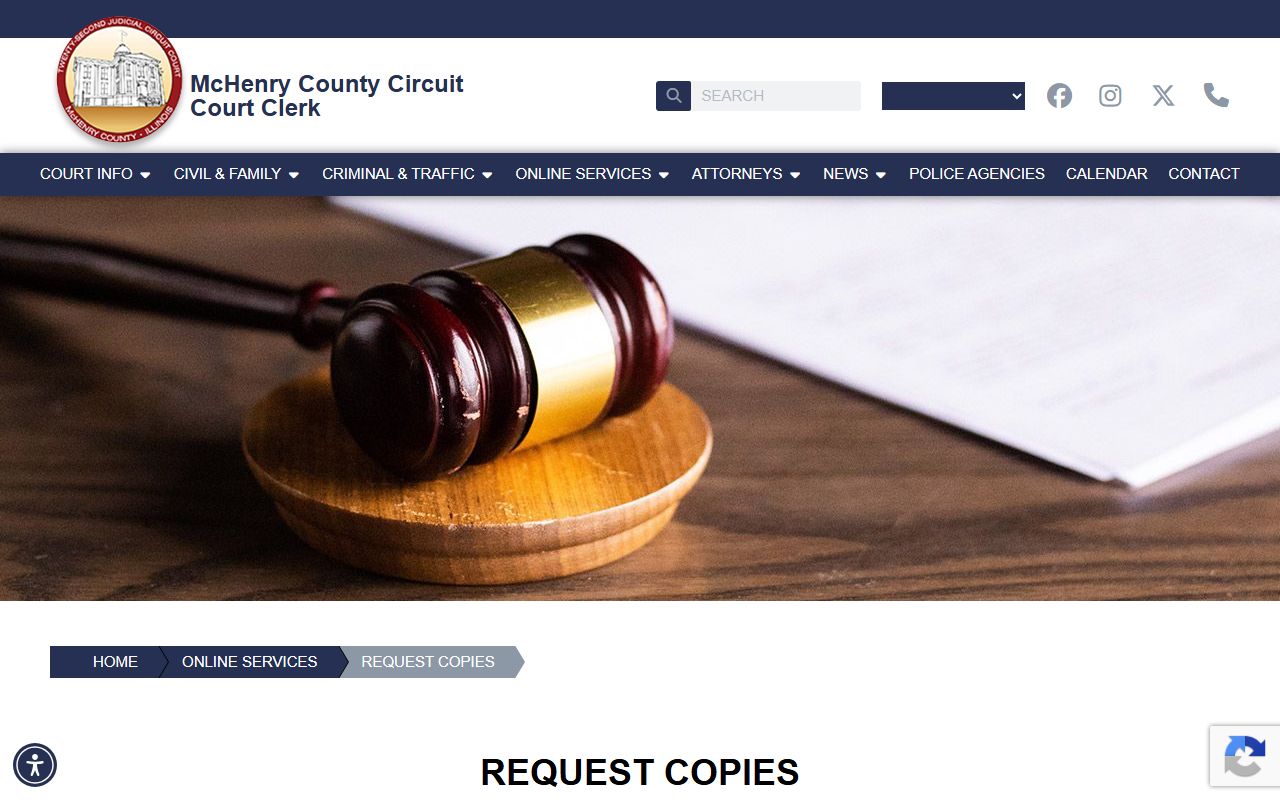
The request-copies page asks for the case number, party names, document title, and file date, and it notes that transcripts, police reports, and evidence are not in the court file. Police reports come from the arresting agency, not the clerk.
Restricted Court Records After an Arrest in McHenry County
Some cases are closed to the public no matter how they began. Adoption, juvenile abuse and neglect, juvenile delinquency, mental-health, and impounded cases are excluded from public files, along with expunged and sealed matters. Inside an otherwise public file, certain documents are restricted, such as financial statements, medical records, Social Security numbers, and victim names in sexual-assault cases. Under 5 ILCS 140/7, agencies may also withhold records tied to active investigations or safety concerns.
Important: This site is a private reference and not a consumer reporting agency under the FCRA, so nothing here may be used for employment, housing, credit, or other FCRA-covered screening.